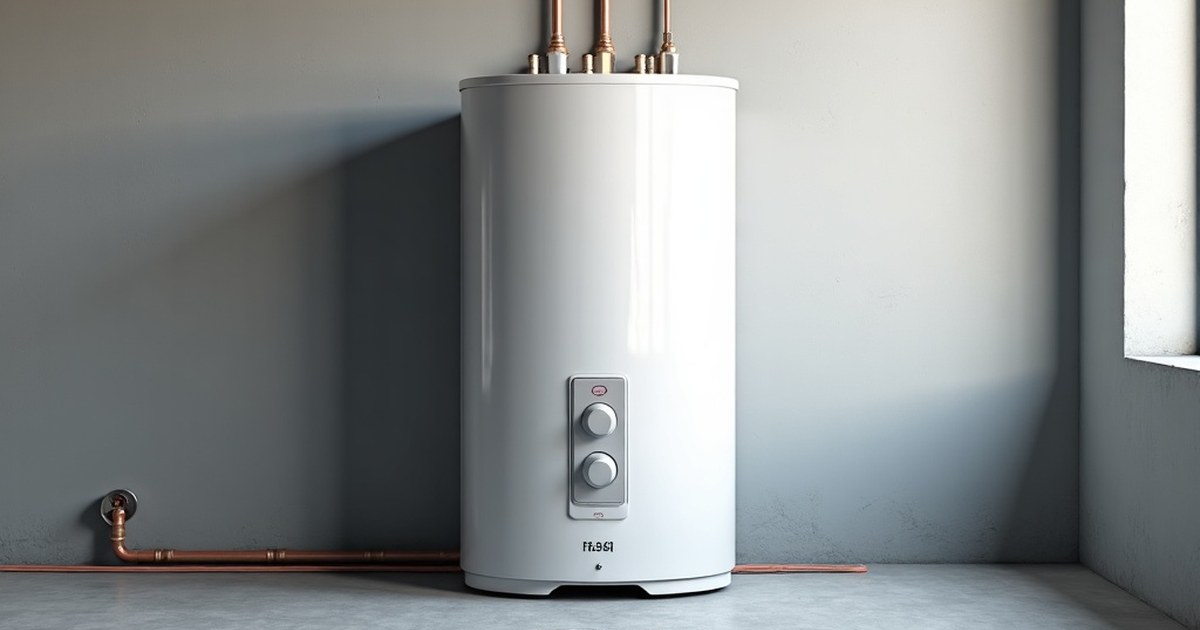
You walked into the basement and found a puddle under the water heater. Before you assume the worst and start pricing a new unit, you need to know one thing: where the water is coming from decides whether this is a $150 fix or a $2,000 replacement. A water heater leaking from a fitting at the top is a different problem than one weeping from the bottom of the tank, and confusing the two is how people pay for a new heater they did not need.
The tank body and the connections bolted to it fail in completely different ways. A loose valve or a corroded fitting is a repair. A rusted-through tank is a replacement, full stop. Most of the panic around a leaking water heater comes from treating every drop of water as a death sentence for the whole unit. It usually is not. Here is how to tell which one you have and what each path actually costs in 2026.
Where the water is actually coming from
Stand back and find the source before you touch anything. Wipe the unit dry, put down a paper towel, and watch where the wet spot returns. Nearly every leak traces to one of these points, and they are not equally serious.
- The drain valve at the bottom. A plastic spigot that can loosen, crack, or fail to seat after a flush. Cheap and fixable.
- The temperature and pressure (T&P) relief valve. The safety valve near the top with a discharge pipe running down the side. Water here is often a warning, not a defect. More on that below.
- The inlet and outlet connections at the top. The cold-in and hot-out pipe fittings. Loose or corroded unions drip here. Fixable.
- The anode rod port. The hex plug on top that houses the sacrificial rod. Can seep if the gasket fails.
- The tank itself. Water rising from the base with no obvious source above it usually means the steel tank has corroded through from the inside. This is the one that ends the unit.
The rule that matters: water from a valve, a fitting, or a connection is almost always a repair. Water from the tank body is almost always a replacement. Bottom leaks with a dry top point to internal tank failure, and once a tank is rusted through there is no patch that lasts.
Water heater repair cost by leak source (2026)
These are installed prices, part plus labor, for a licensed plumber. Most carry a $75 to $200 service or diagnostic fee, and labor runs roughly $45 an hour in rural areas up to $150 an hour in coastal cities. The same repair costs more in Seattle than in Tulsa.
| Repair | Part cost | Installed total |
|—|—|—|
| Tighten or replace drain valve | $10 to $25 | $100 to $200 |
| T&P relief valve | $20 | $100 to $300 |
| Inlet / outlet fitting or union | $10 to $40 | $150 to $350 |
| Anode rod | $20 to $50 | $150 to $350 |
| Heating element (electric) | $20 to $60 | $100 to $350 |
| Thermostat (electric) | $20 to $30 | $150 to $250 |
| Thermocouple (gas) | $10 to $40 | $100 to $325 |
| Gas control valve (gas) | $100 to $300 | $150 to $550 |
| Expansion tank (add-on fix) | $40 to $200 | $150 to $450 |
| Replace tank unit | Varies | $900 to $2,500 |
Everything above the last row is a repair that keeps a sound tank running for a fraction of a replacement. The bottom row is where the math changes, and tank age is what decides whether you spend it.
The hidden trap: a leaking T&P valve is usually a pressure problem
Here is the misdiagnosis that sends people down the wrong road. Water is dripping from the T&P valve or its discharge pipe, a plumber swaps the valve for $150, and three weeks later it is dripping again. The homeowner assumes they got a bad part. They did not. The valve was doing its job.
The T&P valve is a safety device. It opens and releases water when pressure inside the tank climbs too high, usually past 150 psi. If it keeps leaking, the real question is why the pressure is spiking, and the answer is almost always one of two things. Either your incoming municipal water pressure is above 80 psi, or your system has no working expansion tank to absorb the swell when water heats and expands. A 40-gallon tank pushes out roughly half a gallon of extra volume every heating cycle. With nowhere to go, that pressure hammers the valve until it weeps.
Replacing the valve alone treats the symptom. The actual fix is a pressure gauge on a hose bib to check supply pressure, a pressure-reducing valve if it reads high, and a properly sized expansion tank if you do not have one. An expansion tank runs $150 to $450 installed, which sounds like more than a $20 valve, until you count the repeat visits and the strain that same pressure is putting on the tank itself. So when a T&P valve leaks, do not just say replace it. Ask what the water pressure is and whether there is an expansion tank. That one question separates a real fix from a recurring drip.
The other trap runs the opposite direction. A little water at the base is not automatically a dead tank. Condensation on a gas unit, a slow drip from the drain valve running down the side, or a T&P discharge pooling at the bottom can all look like tank failure from across the room. Dry the whole unit, watch it, and confirm the water is truly rising from the tank seam before anyone quotes you a replacement.
Repair or replace: the decision framework
A standard tank water heater lasts 8 to 12 years. A tankless unit lasts 15 to 20 years or more. A new tank runs $900 to $2,500 installed, with most standard swaps landing around $1,200 to $1,800. Going tankless runs $1,400 to $3,900, and converting from tank to tankless pushes higher, often $4,000 or more, because the job can take twice as long and needs new venting and gas or electrical work.
The trade rule is simple: replace when the repair quote exceeds half the cost of a new install, or when the tank itself is the thing leaking. Layer age on top of that and the call is usually obvious.
Repair if:
- The leak is at a valve, a fitting, the drain, or a connection, not the tank body
- The unit is under 8 years old and this is its first failure
- The fault is a heating element, thermostat, thermocouple, or gas valve on an otherwise sound tank
- The repair quote is under half the price of a new install
- A leaking T&P valve traces to pressure or a missing expansion tank, both fixable
Replace if:
- Water is rising from the base of the tank with a dry top, the classic sign of internal corrosion
- The tank is past 10 to 12 years old and needs any significant repair
- The repair quote clears half the cost of a new unit
- You are seeing rusty hot water or stacking repairs across a couple of years
- The anode rod was never changed and the tank is a decade old, meaning corrosion is likely advanced
DIY if: the fix is genuinely simple and does not involve gas. Tighten the fittings at the top with a wrench. Replace a leaking drain valve on an electric unit after shutting off power and water. Test the T&P valve by lifting its lever. Flush the tank once a year to slow sediment. What you do not DIY is anything on a gas unit’s burner or control valve, any electrical element while unsure the power is off, or the tank itself. Draining and hauling a full 50-gallon heater is a two-person job, and a bad reconnection on a gas line is dangerous. Those are pro jobs.
Bottom line
A leaking water heater is a repair more often than the puddle suggests. Find the source first, because that single fact decides everything. Water from the drain valve, a fitting, or the T&P valve is a $100 to $550 fix that keeps a good tank running. Water rising from the bottom of the tank on a unit past a decade old is a replacement, and no repair will hold. When the T&P valve keeps dripping, chase the pressure and the expansion tank instead of swapping the valve twice. Save the $1,200-plus replacement for a tank that has actually failed or aged out, and you will not overpay for a fix a wrench and a $20 part could have handled.
FAQ
Is a leaking water heater an emergency?
It depends on the source and the volume. A slow drip from a fitting or the T&P valve is not urgent, but you should still address it soon. A steady flow or water rising from the base of the tank calls for shutting off the water supply and the power or gas right away, then calling a plumber. Standing water near electrical or gas connections is the part to take seriously.
Can you repair a water heater that leaks from the bottom?
Usually no. A leak from the bottom of the tank with no drip from the valves or fittings above almost always means the steel tank has corroded through from the inside. Tanks are not repairable once they rust through, so a true bottom-tank leak means replacement. Confirm the source first, because a drain valve or T&P discharge can pool at the base and mimic tank failure.
Why does my T&P valve keep leaking after replacement?
Because the valve was never the real problem. It leaks when tank pressure spikes, usually from municipal water pressure above 80 psi or a missing or waterlogged expansion tank. Fix the pressure with a pressure-reducing valve and add an expansion tank, and the dripping stops. Swapping the valve alone treats the symptom.
How long should a water heater last before I replace it?
A standard tank lasts 8 to 12 years, and a tankless unit lasts 15 to 20 or more. Once a tank passes 10 to 12 years and needs any real repair, replacement is usually the smarter money. Changing the anode rod every 3 to 5 years is the single best way to stretch a tank toward the top of that range.
Related reading
- Is It Worth Repairing a 3 to 5 Year Old Appliance?
- Refrigerator Ice Maker Replacement Cost vs New Fridge
- Dishwasher Not Heating or Drying? Repair vs Replace vs DIY
- Washing Machine Loud Banging During Spin Cycle
- Dryer Door Latch Replacement Cost vs New Dryer
Cost ranges cross-checked against HomeGuide’s 2026 water heater repair cost data.
Leave a Reply