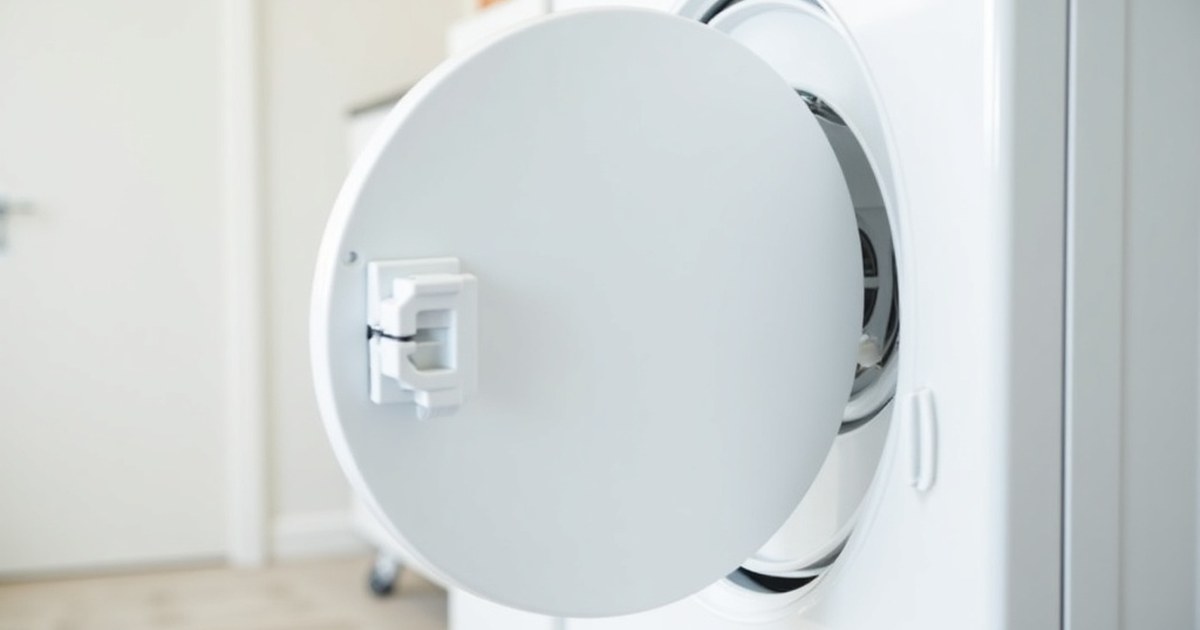
Your dryer door won’t stay closed, and now you’re wondering whether a repair makes sense or whether this is the universe telling you to finally buy a new machine. Here’s the truth: a broken dryer door latch is one of the cheapest appliance repairs a homeowner can make. In most cases, the part costs $15–60 and the job takes under an hour. Even with a service call, you’re rarely looking at more than $150–200.
So no, this is almost never a reason to spend $400–2,000 on a new dryer. But there are exceptions worth knowing, and there’s a real problem with cheap replacement latches that fail again within months. That’s where people go wrong.
What a Dryer Door Latch Actually Costs to Replace
The dryer door latch system has two parts: the latch itself (the plastic or metal hook on the door) and the strike (the catch built into the dryer body). Either one can fail, and sometimes both need replacing at the same time. A dryer door latch strike assembly typically runs $10–30 for the part alone. Full kits that include both pieces run $20–60.
DIY Dryer Door Latch Replacement Cost
- Part only (latch or strike, generic): $10–25
- OEM or brand-specific kit (Whirlpool, Maytag, GE, LG): $25–60
- Your time: 30–60 minutes if you follow a model-specific video
- Tools needed: Usually just a Torx or Phillips screwdriver
Total DIY cost: $30–80 in most cases, including any basic tools you might need to pick up. If you already own an appliance repair screwdriver set, it’s closer to $15–60.
Professional Dryer Door Latch Replacement Cost
- Service call / diagnostic fee: $60–100 (sometimes waived if you proceed with repair)
- Labor for the latch replacement: $50–100
- Part markup (technician-supplied): typically 20–50% above retail
Total professional cost: $100–250 in most US markets. In high-cost cities like San Francisco, New York, or Boston, budget $150–300. In lower-cost regions, $100–175 is realistic. The job itself is straightforward, so labor time is minimal. You’re mostly paying for the trip.
Repair vs. Replace: The Honest Decision Framework
A door latch failure alone is almost never a valid reason to replace a dryer. The repair-to-replacement cost ratio is extreme: you’d be spending $400–2,000 to avoid a $50–150 fix. But before you order the part, run through these questions.
How Old Is the Dryer?
Dryers typically last 10–13 years with normal use. If yours is under 8 years old, fix it without hesitation. A latch repair on a younger machine is straightforward math: $50–150 repair vs. $400+ replacement, for a machine that likely has 5–8 years of life left.
If the dryer is 10–12 years old, the latch repair still makes sense on its own, but be honest with yourself. Is this the third repair in two years? Are you also chasing a heating element, a drum belt that’s getting noisy, or a control panel that’s acting up? A single latch fix on an aging machine is still worth it. Stacking $300–500 in repairs on a 12-year-old dryer is a different conversation.
Is It Really Just the Latch?
Misdiagnosis is the hidden cost nobody talks about. Before you order parts, confirm the latch is the actual problem. A door that won’t close and latch properly can also be caused by a warped door, a worn hinge, or a door switch that’s failing (which can also prevent the dryer from starting). The latch is the most common culprit, but spend five minutes checking the door alignment and listening for a click when you press the door closed manually. If the latch mechanism clicks but the dryer still won’t run, the door switch is likely the real issue. That’s a separate part, though also inexpensive at $10–30.
The Repeated-Failure Problem: Why Cheap Latches Break Again
Here’s what the parts-listing sites won’t tell you. A significant number of homeowners who fix a dryer door latch find themselves back at square one within 6–18 months. The reason is almost always the same: they bought the cheapest generic latch available.
Low-cost universal plastic latches, particularly no-brand units sold in bulk on marketplaces, are often made from brittle nylon or thin ABS plastic. Dryer doors get slammed. Kids do it. Habits die hard. Cheap plastic doesn’t survive that pattern for long.
The fix is simple: buy a brand-specific latch kit for your dryer manufacturer rather than a universal option. OEM-equivalent parts from brands like Whirlpool, Maytag, GE, and LG are designed to the original tolerances and made from the same materials as the factory part. They cost $5–20 more than a generic, and they last years longer. If your dryer is a Whirlpool or Maytag platform (which covers an enormous range of brands), a proper dryer door latch replacement kit designed for that platform is worth the extra spend every time.
When comparing options, look for these markers of durability:
- Metal strike plate, not plastic-on-plastic contact points
- OEM or OEM-equivalent designation, not just “universal fit”
- Seller with documented model compatibility list
- Reviews that specifically mention longevity, not just ease of installation
Repair vs. Replace Comparison
| Scenario | Estimated Cost | Verdict |
|---|---|---|
| DIY latch repair, dryer under 8 years old | $30–80 | Repair. Clear winner. |
| Professional repair, dryer under 8 years old | $100–250 | Repair. Still strong ROI. |
| Professional repair, dryer 10–12 years old, no other issues | $100–250 | Repair, but monitor closely. |
| Latch + other repairs stacking up, dryer 12+ years | $300–600 cumulative | Consider replacing. |
| New mid-range dryer (budget to mid-tier) | $400–800 | Replace only when repair math fails. |
| New energy-efficient dryer | $700–1,200 | Worthwhile if your current dryer is inefficient and aging. |
If you do decide a replacement makes more sense for an older machine, it’s worth looking at energy-efficient dryers under $800 before assuming you need to spend more.
DIY or Call a Tech? Be Honest About the Job
Replacing a dryer door latch is one of the most beginner-friendly appliance repairs on the list. You don’t need to pull the machine apart or touch any electrical components. In most cases, it’s a few screws, a snap-in or slide-in part, and you’re done. YouTube has model-specific videos for virtually every major dryer brand.
That said, call a technician if: you can’t confidently identify the right part for your model, the door itself is warped or the hinge is damaged (that’s a different job), or you’ve already attempted the repair and something still isn’t right. Misdiagnosis costs more than a service call when you’ve already bought two wrong parts.
Check the model number sticker inside the door frame before ordering anything. That number will get you the exact compatible part instead of guessing. Sites like [EXTERNAL LINK: Repair Clinic] let you enter your model number and see the correct part directly. ENERGY STAR’s dryer resources at energystar.gov can help if you’re evaluating whether an aging, inefficient dryer is worth replacing on energy-cost grounds.
Frequently Asked Questions
Is it cheaper to replace a dryer door latch or buy a new dryer?
Replacing the latch is almost always cheaper, often by a factor of 10 or more. A DIY repair runs $30–80; a professional repair runs $100–250. A new dryer starts at $400 and typically costs $600–800 for a reliable mid-range model. Unless your dryer is over 12 years old and already showing multiple problems, fix the latch.
How much does it cost to replace a dryer door latch professionally?
In most US markets, expect to pay $100–250 for a professional dryer door latch replacement, including the service call, labor, and part. Labor rates vary regionally; high-cost cities can push the total to $200–300. The repair itself is quick, so labor charges are typically on the lower end of a technician’s rate card.
Can you DIY replace a dryer door latch and save money?
Yes, and it’s one of the easier DIY appliance repairs available. You’ll need the correct replacement part for your dryer model and a basic screwdriver. Most homeowners complete the job in 30–60 minutes following a model-specific video. The main risk is ordering the wrong part, so always use your dryer’s model number to confirm compatibility before buying.
Leave a Reply